

Aware watches for risks like water, mold, freezing, HVAC issues, and unhealthy home conditions.

Balance helps maintain the ideal indoor environment by managing humidity and temperature for whole-home comfort.

Breathe helps manage ventilation, filtration, humidity, and air quality for a healthier indoor environment.

Sendal services are delivered through participating home-service professionals who understand your home’s systems and can help respond when attention is needed.
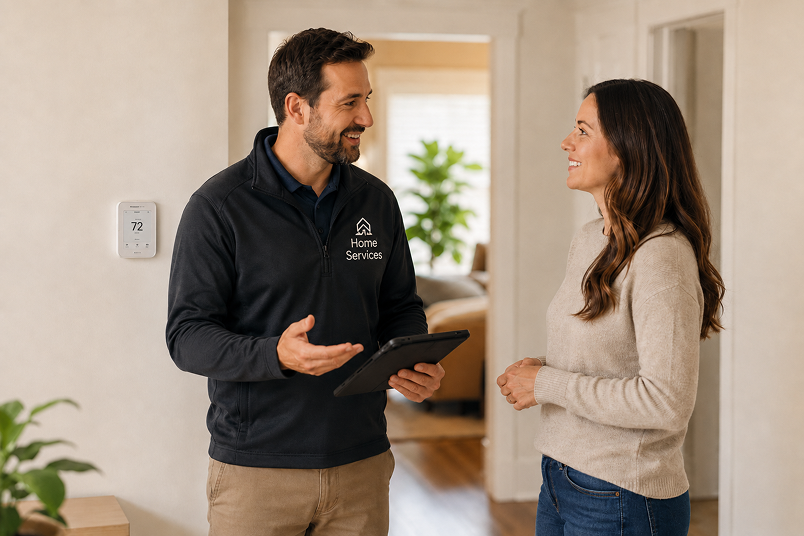
“The [Breathe] system is very automated and does not require any direct management on my part, which is great. It has been working excellently and I frequently notice the fans and fresh air system automatically turned on when the air quality has dropped and it makes a big difference.”
"After trying various solutions to automate IAQ, Sendal proved to be the only solution capable of delivering the best possible air – keeping my family safe."
“We haven’t had to adjust the temperature once. The apartment feels incredibly comfortable, the air feels fresh and light, and we can truly feel the difference. We’re very happy with the results.”

Whether your priority is cleaner air, better comfort, early warning, or protecting your home’s systems, Sendal helps your home work more intelligently.
Want Sendal, but your contractor is not a dealer?
A monitor alone can't guarantee healthy indoor air—and new research proves it. Studies show ventilation systems often aren't installed correctly (or aren't even running), CO₂ readings can look fine while particle pollution stays high, and pulling in more outdoor air isn't always the answer. This post breaks down what the latest science reveals about the gaps in single-point IAQ solutions, and why coordinating ventilation, filtration, humidity control and real-time conditions—the approach behind Sendal's Breathe service—is what actually turns readings into a healthier home.
Sendal Inc. today launched Sendal Aware (July 7, 2026), a proactive monitoring service for HVAC and home-service companies that builds on its Breathe and Balance offerings. Aware detects early warning signs—HVAC failures, excess heat/humidity, mold and freeze risk, power outages, poor indoor air quality, and drain-pan water—then alerts contractors (and homeowners when appropriate) so issues can be addressed earlier. The service helps contractors retain customers, create recurring revenue, and uncover service opportunities; Sendal cites >98% year‑over‑year retention from Breathe and Balance deployments. Aware is available to home service companies now; contact info@sendal.io or visit Sendal.io.
For decades, the residential building industry has leaned heavily on ASHRAE 62.2 as the reference point for indoor air quality. This has helped move homes in the right direction by requiring mechanical ventilation in tighter, more energy-efficient buildings. However, the industry has often treated compliance with ASHRAE 62.2 as if it were equivalent to delivering healthy indoor air.


